

Imagine standing before a high-stakes challenge where every metric determines your next breakthrough or a critical failure. Whether you are navigating elite academic admissions, verifying structural integrity, or deploying mission-critical code, the precision of a Test defines the boundary between uncertainty and absolute mastery. We break down these rigorous validation protocols to provide you with the definitive framework for interpreting performance and ensuring uncompromising reliability across every professional domain.
- Test Architecture: Defining the Spectrum of Human Performance
- Industrial Fortitude: Stress Protocols and Material Validation
- Scientific Rigor: Statistical Logic and Experimental Boundaries
- System Intelligence: Digital QA and Performance Interpretation
Test Architecture: Defining the Spectrum of Human Performance
We often reduce the word Test to a simple school memory. In reality, it forms the backbone of how we measure human potential and biological health.
Academic Rigor in Standardized Exams
Academic assessment measures knowledge through structured verification. It validates learning progress beyond simple grades, ensuring intellectual growth is accurately tracked. This verification is essential for educational integrity.
Standardized exams provide critical credentialing. Elite institutions like Yale now utilize standardized testing requirements via flexible policies. These benchmarks identify academic readiness across diverse global backgrounds.
Formative methods guide the student's journey. Summative exams mark the final destination of their effort.
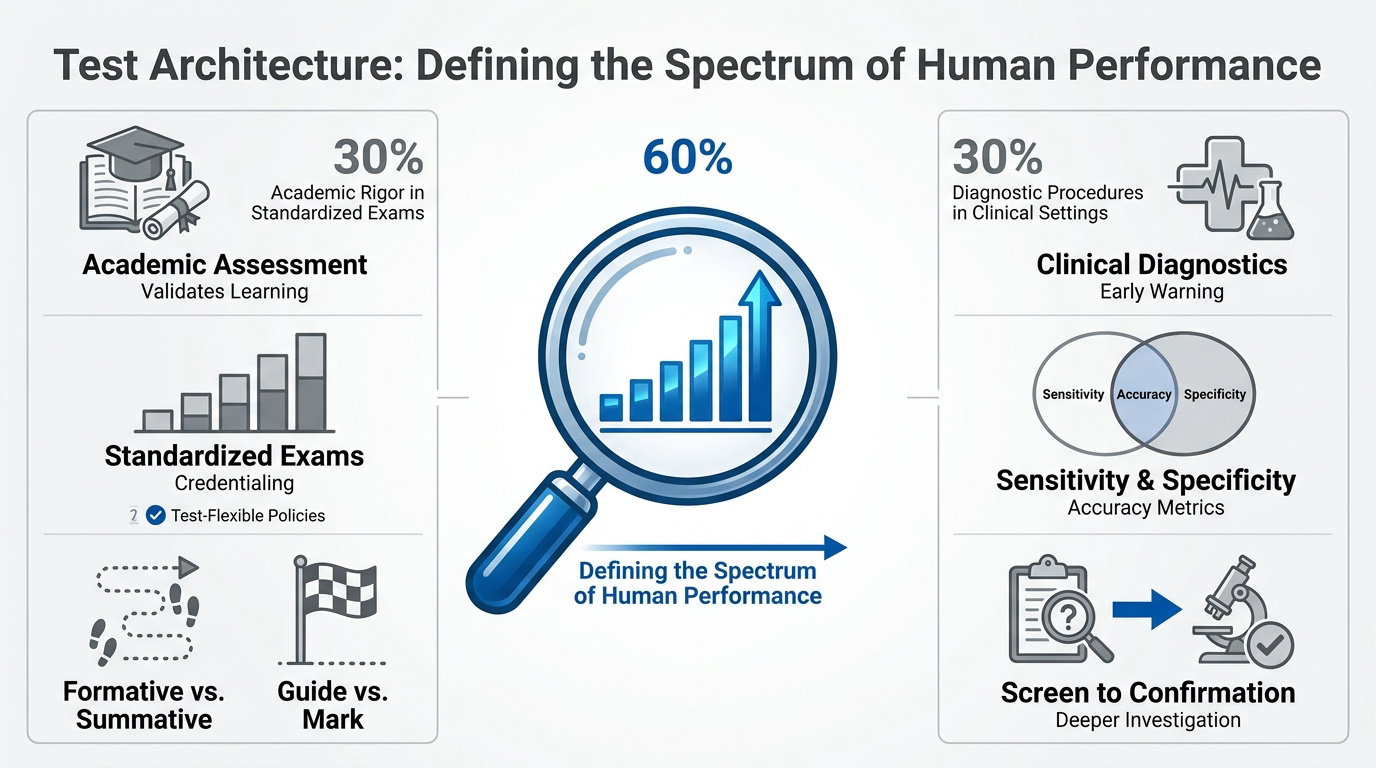
Diagnostic Procedures in Clinical Settings
Medical screenings act as early warning systems. They catch biological issues before they escalate, making them vital for long-term health monitoring and preventative care.
High sensitivity avoids missing critical cases. High specificity ensures healthy people aren't treated by mistake. Balancing these metrics is mandatory for clinical accuracy and patient safety.
A positive screen is just the start. It requires deeper investigation to reach a final clinical diagnosis.
Industrial Fortitude: Stress Protocols and Material Validation
While humans face exams, the physical world undergoes its own trials, moving from the classroom to the harsh reality of industrial stress testing.
The UK's MOT (Ministry of Transport) test is a mandatory annual check for vehicles, covering road safety and emissions across 20+ systems.
Material Endurance and Structural Stress Testing
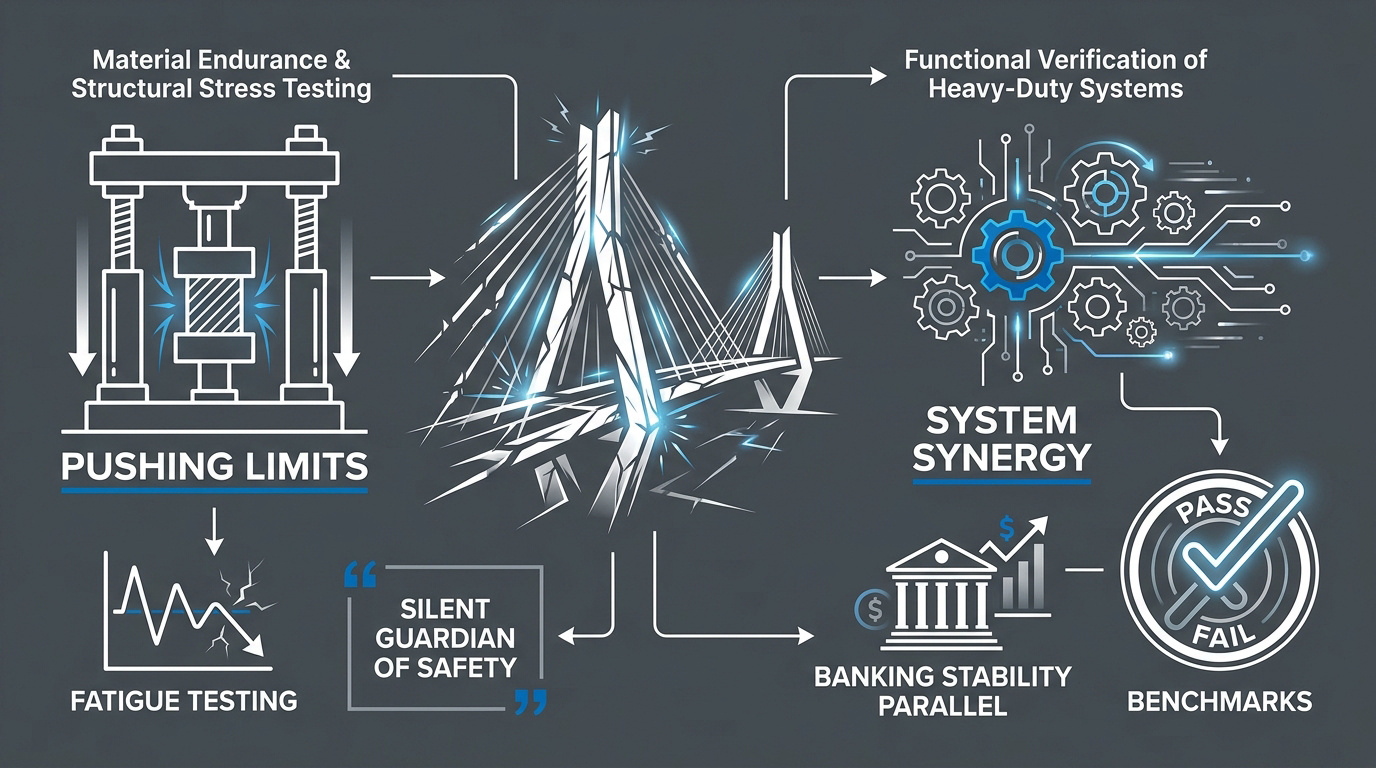
Engineers deploy rigorous mechanical stress protocols. They push steel and concrete to their limits. This ensures bridges don't fail under pressure.
Fatigue testing involves repeated cycles. These reveal hidden weaknesses. It is a slow battle against wear.
Every crack and groan is recorded. Technical logs ensure total authenticity.
Material testing is the silent guardian of public safety, ensuring that every bolt and beam performs exactly as promised under extreme duress.
Functional Verification of Heavy-Duty Systems
Complex hardware requires perfect synchronization. Systems must work together perfectly. One small error leads to massive failure.
Safety standards define high-performance engineering. Consider the bank stress tests approach as a parallel. Stability remains the ultimate goal.
Benchmarks are strictly binary. Machines either survive the protocol or fail. Results determine if a design moves forward.
Scientific Rigor: Statistical Logic and Experimental Boundaries
Beyond physical materials, the "test" becomes an abstract framework, where logic and numbers replace hammers and fire to find the truth.
Statistical Frameworks for Hypothesis Validation
Rigorous validation begins with a fundamental doubt. We formulate an initial hypothesis to challenge existing assumptions. Data then dictates whether this skepticism holds any weight.
Metrics like p-values and confidence intervals define our boundaries of certainty. The scientific journal TEST serves as a primary reference for these methodologies. They quantify the probability of chance.
Interpreting data-driven outcomes requires a cold, objective eye. Results must be viewed through a strictly logical lens. Without context, numbers can mislead even the most brilliant minds.
Distinguishing Controlled Tests from Open Experiments
A test verifies a known variable against a standard. An experiment explores the unknown to generate new theories. While related, their strategic goals remain fundamentally different.
Focus on verification and checking known variables to ensure specific compliance or performance.
Focus on discovery and exploring unknowns to uncover new phenomena or complex relationships.
Scientists isolate factors to ensure absolute precision. This isolation is achieved through specific structural elements:
- Control groups
- Independent variables
- Dependent variables
- Constants
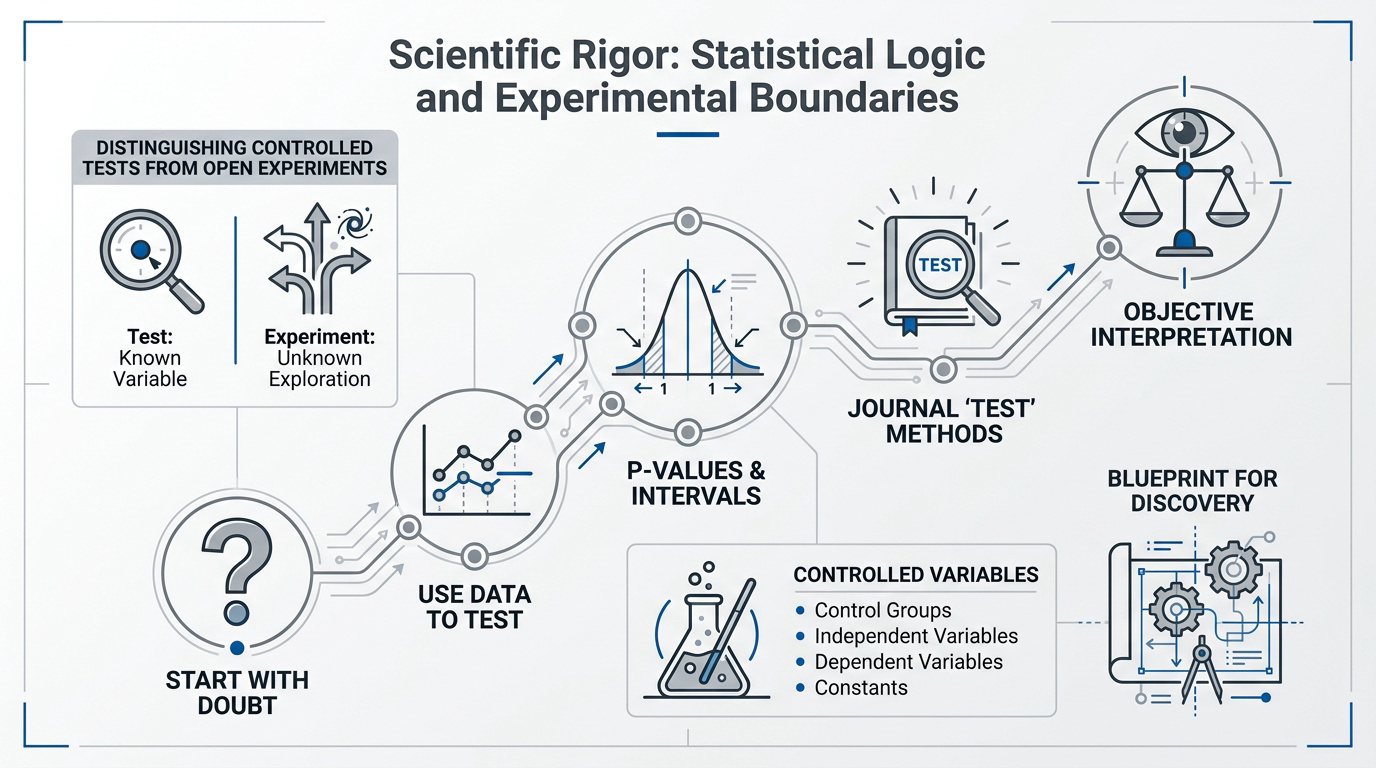
Experimental design serves as the definitive definitive blueprint for discovery. It provides the necessary structure to prevent bias. Proper design ensures that final results remain untainted.
System Intelligence: Digital QA and Performance Interpretation
Finally, we enter the digital realm, where testing happens in milliseconds and code is scrutinized by automated sentinels.
Automated Validation in Modern Software Architecture
Software QA is the wall between a bug and the user. It ensures that the digital experience remains smooth and reliable. This protection is non-negotiable for performance.
Scripts now do what humans used to do. This speed allows for constant updates without breaking the entire system. Efficiency is the new standard in modern deployment.
Testing is no longer the final step. It happens every time a developer writes a single line of code. Integration is now seamless and continuous.
Best Practices for Interpreting High-Velocity Data
Analyze the speed and the error rates. Every millisecond counts in the modern web. Sharp strategies are required to maintain a competitive edge.
Algorithmic testing, like the NIST Face Recognition Vendor Test, provides high-stakes digital evaluation. These frameworks turn raw data into elite intelligence for global systems.
| Testing Domain | Primary Goal | Key Metric | Example Tool |
|---|---|---|---|
| Academic | Knowledge | Linear Temporal Logic | ADL Frameworks |
| Industrial | Safety | Compliance Rate | MOT Standards |
| Scientific | Validation | FMR / FNMR | NIST FRVT |
| Software | Stability | Runtime Verification | LAVA (Linaro) |
Reliability is the core of any good metric. A Test is only valuable if the results are precise. Transparency remains the ultimate benchmark for digital success.
"In the digital age, a test is only as good as the data it produces, making transparency the ultimate benchmark for success."
Mastering every test—from clinical diagnostics to industrial fatigue protocols—ensures peak performance and uncompromising safety. By validating knowledge and structural integrity today, you secure a reliable, high-velocity future. Elevate your standards now to achieve legendary results across every critical domain.
FAQ
How do elite universities utilize standardized assessments in their selection process?
Top-tier academic institutions have aggressively pivoted back to standardized metrics like the SAT and ACT to validate student potential. While some maintain test-flexible or test-optional policies, elite schools increasingly view these scores as a critical, objective benchmark for predicting first-year success in high-pressure environments.
These exams serve as a vital calibration tool, allowing admissions officers to differentiate between candidates in an era of grade inflation. By providing a consistent data point, these assessments ensure that academic rigor remains the cornerstone.
What is the significance of sensitivity and specificity in clinical screenings?
In the high-stakes world of medical diagnostics, sensitivity represents the "true positive" rate, ensuring that the test successfully identifies every individual carrying a condition. High sensitivity is the ultimate defensive line, acting as an early warning system to catch issues before they escalate.
Conversely, specificity measures the "true negative" rate, preventing the catastrophic error of treating healthy patients by mistake. Balancing these two metrics is essential for clinical confirmation, transforming a preliminary screen into a definitive roadmap for patient care.
How does fatigue testing ensure the structural integrity of industrial materials?
Engineers subject materials like steel and concrete to brutal, repetitive cycles of tension and compression to reveal hidden structural weaknesses. This fatigue testing creates a "stress-strain" profile (S/N curve) that predicts exactly when a component will fail under real-world duress.
By simulating years of wear in a controlled environment, these protocols safeguard public infrastructure. Whether it is axial, bending, or shear testing, these rigorous simulations ensure that every bolt and beam performs with absolute reliability throughout its operational lifespan.
What distinguishes a controlled scientific test from an open-ended experiment?
A rigorous test is designed to verify a known variable against a binary pass-fail benchmark, whereas an experiment is a journey into the unknown. In scientific validation, we utilize hypothesis testing and p-values to establish the boundaries of certainty and eliminate the noise of random chance.
To maintain absolute logic, scientists isolate factors using a strict architectural framework. This includes:
- Control groups for baseline comparison
- Independent variables for active manipulation
- Dependent variables for measuring impact
- Constants to ensure environmental stability
How does automated QA impact the modern digital development cycle?
Quality Assurance (QA) serves as the impenetrable wall between a system-critical bug and the end-user. In today’s high-velocity digital landscape, automated scripts perform validation at speeds impossible for humans, allowing for constant updates without compromising system stability.
This integration means that testing is no longer a final hurdle but a continuous pulse throughout the development journey. Every line of code is scrutinized by digital sentinels, ensuring that performance metrics and user experience remain flawless in real-time.